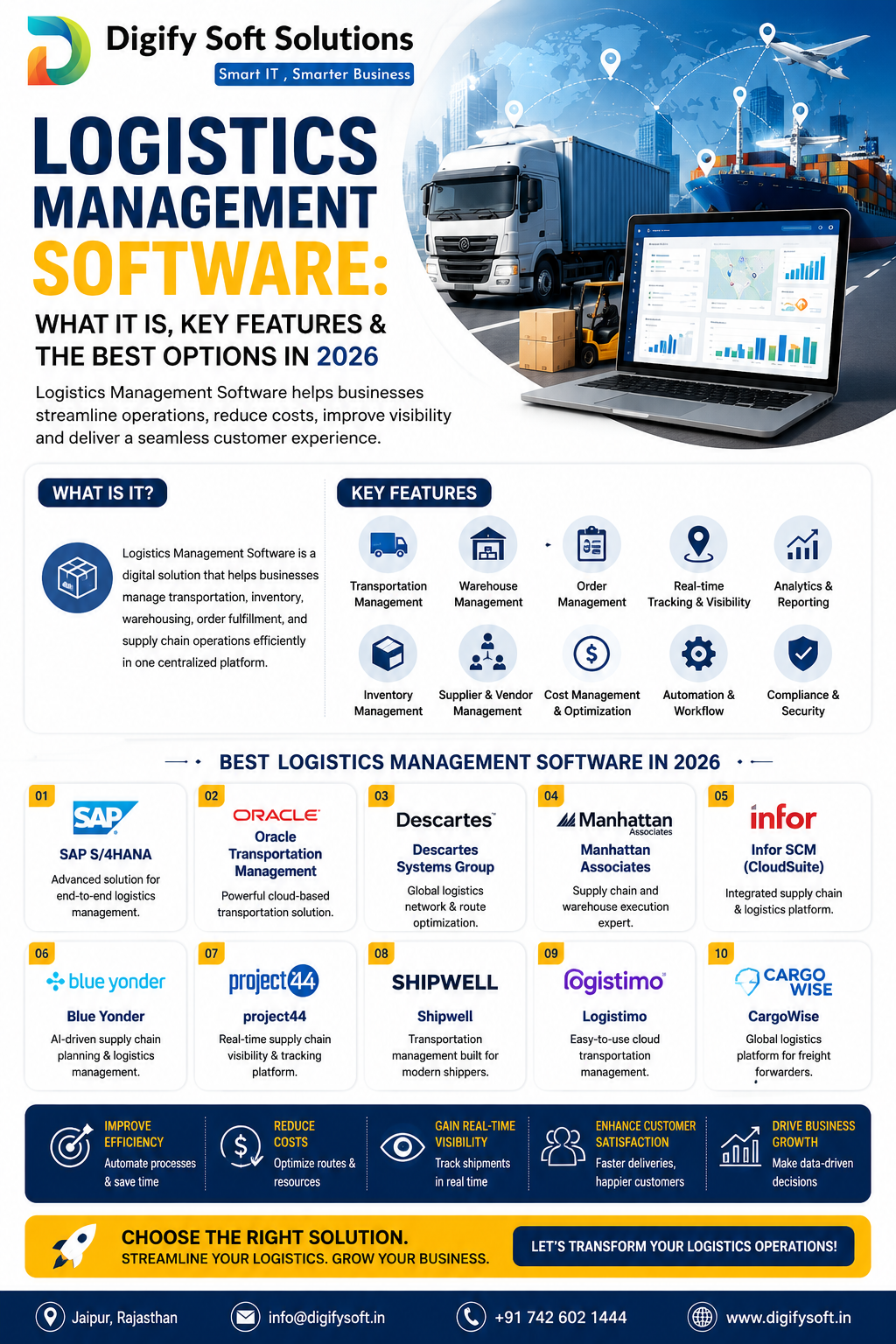
Getting the right product to the right place on time sounds simple until you're managing multiple warehouses, delivery partners, and a fleet of vehicles at once. Logistics management software is what keeps that process from falling apart — connecting dispatch, tracking, and delivery data into one system instead of a dozen phone calls and spreadsheets. Here's a full breakdown of what it does, the features that actually matter, and the best platforms available in 2026.
📋 Table of Contents
- What Is a Logistics Management System and How Does It Work?
- 10 Essential Features of Logistics Management Software
- Benefits of a Logistics Management System
- 9 Best Logistics Management Software of 2026
- Conclusion
- Frequently Asked Questions
What Is a Logistics Management System and How Does It Work?
A logistics management system (LMS) is software that plans, executes, and tracks the movement of goods — from a warehouse or store to the end customer or another business location. Instead of coordinating dispatch, route planning, and delivery confirmation manually across phone calls and paper waybills, an LMS ties the whole process into one dashboard.
In practice, it works in a simple loop:
- Order or dispatch request comes in — from a sales order, warehouse pick, or transfer between locations.
- Route and carrier get assigned — either automatically based on cost/speed rules, or manually by an ops team.
- Shipment is tracked in real time — GPS or carrier API updates flow back into the system as the shipment moves.
- Proof of delivery is captured — digitally, closing the loop and updating inventory and billing.
- Data feeds back into planning — delivery times, delays, and costs get logged to improve future routing decisions.
On a connected platform like DigifySoft, this loop isn't a separate add-on bolted onto your billing software — logistics tracking shares the same backend as inventory and POS billing, so a dispatched order updates stock and delivery status together instead of needing two systems to be manually reconciled.
10 Essential Features of Logistics Management Software
- Real-time shipment tracking — live visibility into where every order is, not just "dispatched" or "delivered."
- Route optimization — automatically choosing the fastest or most cost-effective route rather than a fixed, manual plan.
- Multi-carrier/partner integration — connecting with your actual delivery partners instead of managing each one separately.
- Inventory sync — logistics and stock data updating together so dispatch doesn't outrun what's actually available.
- Proof of delivery (POD) capture — digital signatures or photos confirming delivery, reducing disputes.
- GST-compliant e-way bill generation — automatic, not a manual step outside the system.
- Multi-location dispatch management — routing orders from the nearest warehouse or store rather than a single fixed point.
- Cost and performance analytics — per-route, per-carrier cost and delay data to spot inefficiencies.
- Returns management — handling reverse logistics with the same visibility as outbound shipments.
- Mobile access for delivery staff and managers — updates and confirmations from the field, not just a desktop dashboard.
Benefits of a Logistics Management System
- Faster deliveries — automated routing and dispatch cut the manual delays of phone-based coordination.
- Lower logistics costs — better route and carrier decisions reduce unnecessary mileage and partner fees.
- Fewer disputes — digital proof of delivery resolves "it never arrived" conversations quickly.
- Better customer experience — real-time tracking means customers (and your support team) aren't guessing where an order is.
- Accurate stock data — when logistics and inventory share the same system, stock counts stay correct instead of drifting out of sync.
- Easier compliance — automatic e-way bill and GST documentation reduces manual paperwork and audit risk.
9 Best Logistics Management Software of 2026
1. DigifySoft Logistics
DigifySoft's Logistics module is built to run on the same backend as inventory, POS billing, and omnichannel order routing, so dispatch, delivery tracking, and stock updates happen together instead of needing separate reconciliation. It supports multi-location dispatch, native GST e-way bill generation, and integrations with major shipping and payment partners like Shiprocket, Razorpay, and PhonePe. Because it's part of the same ERP as manufacturing and retail modules, businesses get logistics visibility tied directly to production and sales data rather than a standalone tracking tool.
Best for: Indian retailers, D2C brands, and manufacturers who want logistics tracking connected to inventory and billing on one platform.
2. FarEye
FarEye is a well-known logistics orchestration platform focused on delivery experience management, offering real-time visibility, route optimization, and carrier management for large-scale delivery operations.
Best for: enterprises managing complex, high-volume delivery networks.
3. SAP Supply Chain Logistics
Part of the broader SAP ecosystem, this module handles transportation and logistics planning for large enterprises already running SAP for their core ERP needs.
Best for: large enterprises with an existing SAP deployment.
4. Oracle Transportation Management
Oracle's transportation management solution covers freight planning, execution, and settlement, typically deployed alongside Oracle's broader supply chain suite.
Best for: mid-to-large businesses running Oracle-based supply chain operations.
5. NetSuite Logistics Solutions
NetSuite offers logistics and fulfillment capability as part of its cloud ERP suite, useful for businesses that want transportation visibility tied to their existing financials and inventory.
Best for: growing mid-market businesses already using NetSuite ERP.
6. BluJay Logistics Software
BluJay (now part of E2open) provides transportation management and global trade logistics tools aimed at businesses with complex, multi-region shipping needs.
Best for: businesses managing cross-border or multi-region logistics.
7. Kuebix TMS
Kuebix is a transportation management system focused on freight visibility and carrier rate comparison, often chosen by businesses wanting a simpler, freight-focused tool.
Best for: businesses primarily needing freight and carrier rate management.
8. Trimble's Fleet Mobility Logistics Software
Trimble focuses on fleet management and mobility — vehicle tracking, driver communication, and route compliance — for businesses running their own delivery fleets.
Best for: companies managing an owned vehicle fleet rather than third-party carriers.
9. Optym Logistics Software
Optym provides optimization-focused logistics software, using algorithms to plan routing and scheduling for freight and fleet operations at scale.
Best for: businesses needing heavy-duty route and fleet optimization algorithms.
Conclusion
Most names on this list solve one piece of the logistics puzzle well — freight rates, fleet tracking, or global trade compliance — but usually as a standalone system that still needs to be wired into your inventory and billing separately. For Indian retailers, D2C brands, and manufacturers who'd rather have dispatch, delivery tracking, inventory, and GST compliance running on one connected platform, DigifySoft is built to cover that ground directly, without stitching together multiple vendors.
See it on your own delivery data: Book a free demo or call +91 7425016636.
Frequently Asked Questions
What is the difference between logistics management software and a WMS?
A WMS focuses on stock inside a warehouse — picking, putaway, and storage. Logistics management software focuses on what happens after stock leaves the warehouse — routing, delivery, and tracking. Platforms like DigifySoft combine both so the two aren't managed separately.
Do I need logistics software if I use third-party delivery partners like Shiprocket or Delhivery?
Yes — logistics software sits above individual carriers, letting you compare and route across multiple partners, track everything in one dashboard, and keep delivery data synced with your inventory and billing instead of checking each carrier's portal separately.
Is GST e-way bill generation usually included?
It varies by platform. Enterprise tools like SAP or Oracle often need a separate localization add-on for Indian GST compliance, while India-built platforms like DigifySoft include e-way bill generation natively.
How long does implementation typically take?
Enterprise platforms (SAP, Oracle, FarEye at scale) can take months given the scope of integration. Lighter, India-focused platforms are usually live within a few weeks